Why acid-free matters (and what happens when it isn't)
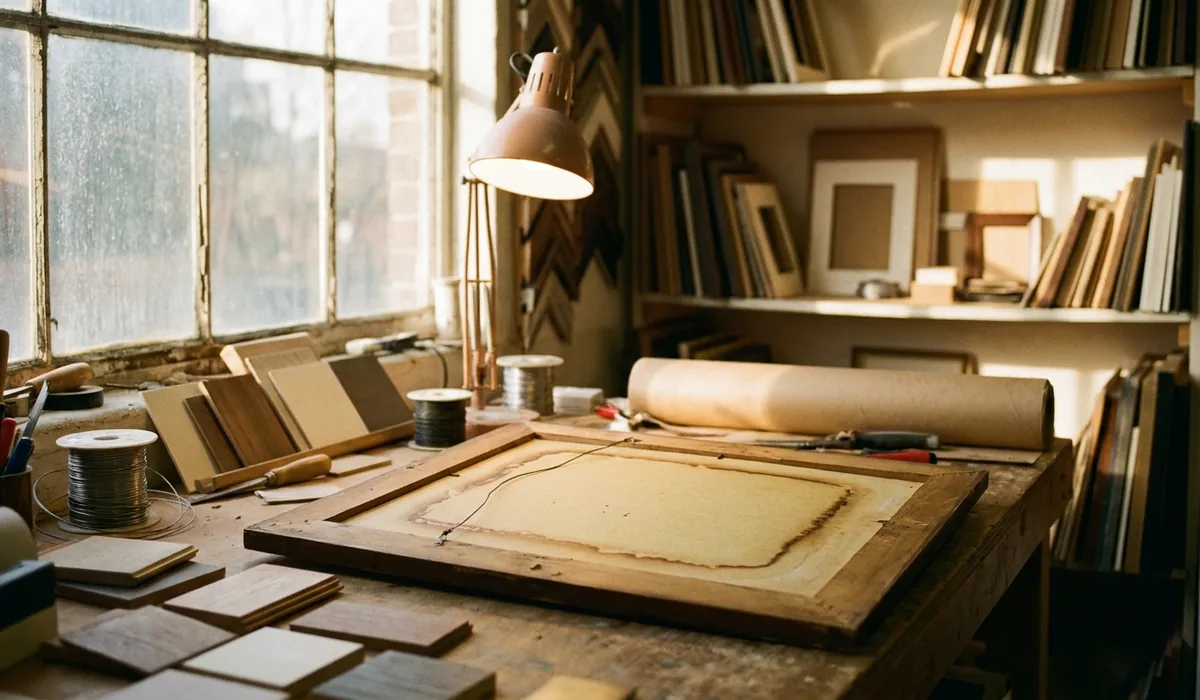
Take an old framed photograph out of its frame and you will often find a brown line running just inside where the mat sat, and a general yellowing across the back. People assume that is simply age. It is not. It is a chemical reaction, and it was avoidable. Understanding it is the single best argument for spending a little more on materials you will never see.
What "acid" is doing in there
Ordinary mat board and backing are made from wood pulp that still contains lignin, the compound that makes wood stiff. Over time, and faster in light and warmth, lignin breaks down and releases acids. Those acids attack the cellulose in both the board and any paper touching it, weakening the fibres and staining them brown. The process is called acid migration, and once it reaches the artwork it cannot be reversed — only slowed.
The damage is not on the wall side. It is coming from the materials pressed against the back of the work.
What acid-free actually means
Conservation board is made so this does not happen. There are two grades worth knowing. "Acid-free" board has been treated to a neutral pH. "Cotton rag" or "museum" board goes further: it is made from cotton fibre, which has no lignin to begin with, so there is nothing to break down. For anything valuable we reach for rag board, and for everything else we still use acid-free — there is no good reason to put ordinary board against artwork.
It is not only the mat. The backing behind the work, the tape or hinges holding it, and even the barrier behind the whole package all matter. A conservation mat over an acidic backing board still lets acid in from behind. We build the whole sandwich from neutral materials, and we hinge works on paper with reversible, acid-free hinges so nothing corrosive ever touches the piece.
Reversibility is the quiet rule
Good conservation framing follows one principle above the rest: anything we do should be undoable. No trimming to fit, no permanent mounting of an original, no glue on the artwork. In fifty years someone should be able to open the frame and find the piece exactly as it went in. That restraint is most of what separates framing that protects from framing that slowly destroys.
If you already own older frames
- If you can see a brown mat line or yellowed backing, the materials are acidic and actively working on the piece.
- It is worth reframing anything with sentimental or monetary value into conservation materials.
- Often the original moulding is fine — we can keep the frame and replace only the mount, hinges, and backing.
None of this shows from the front, which is exactly why it gets skipped. But the mat and backing are the materials in longest, closest contact with your work, and they are the cheapest place to protect it. If you would like a piece checked, bring it in — a look at the back usually tells the whole story. Our note on choosing the right mat covers the visible side of the same decision.